
The Norwich Model Arctic Council for Schools (NORMAC Schools) is still our flagship MAC, and the only stand-alone MAC conference in the world for secondary-school pupils. It’s full of official ceremony, intense diplomatic negotiations, elegant dinners, and of course loads of enjoyable learning. And our ninth NORMAC Schools conference this year was particularly special in that our Honorary Chair was himself a professional diplomat: Mr John Virgoe, recently His Majesty’s High Commissioner in Brunei!

Over 50 pupils took part in NORMAC 9 — 42 delegates from five schools, plus 11 NORMAC Secretariat staff from Norwich School, our long-standing and generous host school. Over the course of the conference, delegates grappled with the complex questions of the so-called ‘Last Ice Area’, and of renewable-energy development in the Arctic. They benefited from the assistance of the NORMAC Secretariat, who served as meeting facilitators and rapporteurs, and they and the Secretariat together also benefited from ‘debriefing sessions’ after each day of negotiations, at which they could reflect on the course of their discussions, as well as about what they had learned.

Those debriefings are a critical part of all of my Polar Aspect MACs. Participating pupils need the time and space to think critically about what they’re doing, in order to transform their experience into learning. The debriefings also provide me as NORMAC Director with an opportunity to offer some teacherly guidance that doesn’t interrupt the flow of the delegates’ own negotiations. At NORMAC 9, delegates were especially lucky also to have the guidance of Mr Virgoe, who generous advice about how to approach negotiations and overcome obstacles carried the weight of deep diplomatic experience.

Usually, debriefing sessions help delegates navigate through the inevitable impasses in their discussions. This year, however, they served perhaps an even more important purpose. Delegates playing the roles of the Indigenous Permanent Participant (PP) organisations believed that their counterparts from the Arctic States were not taking Indigenous rights seriously enough in discussions regarding renewable-energy development in the Arctic. This sort of development raises serious questions of ‘green colonialism’, and in particular of the appropriation of Indigenous land without consent for ‘green’ energy projects.
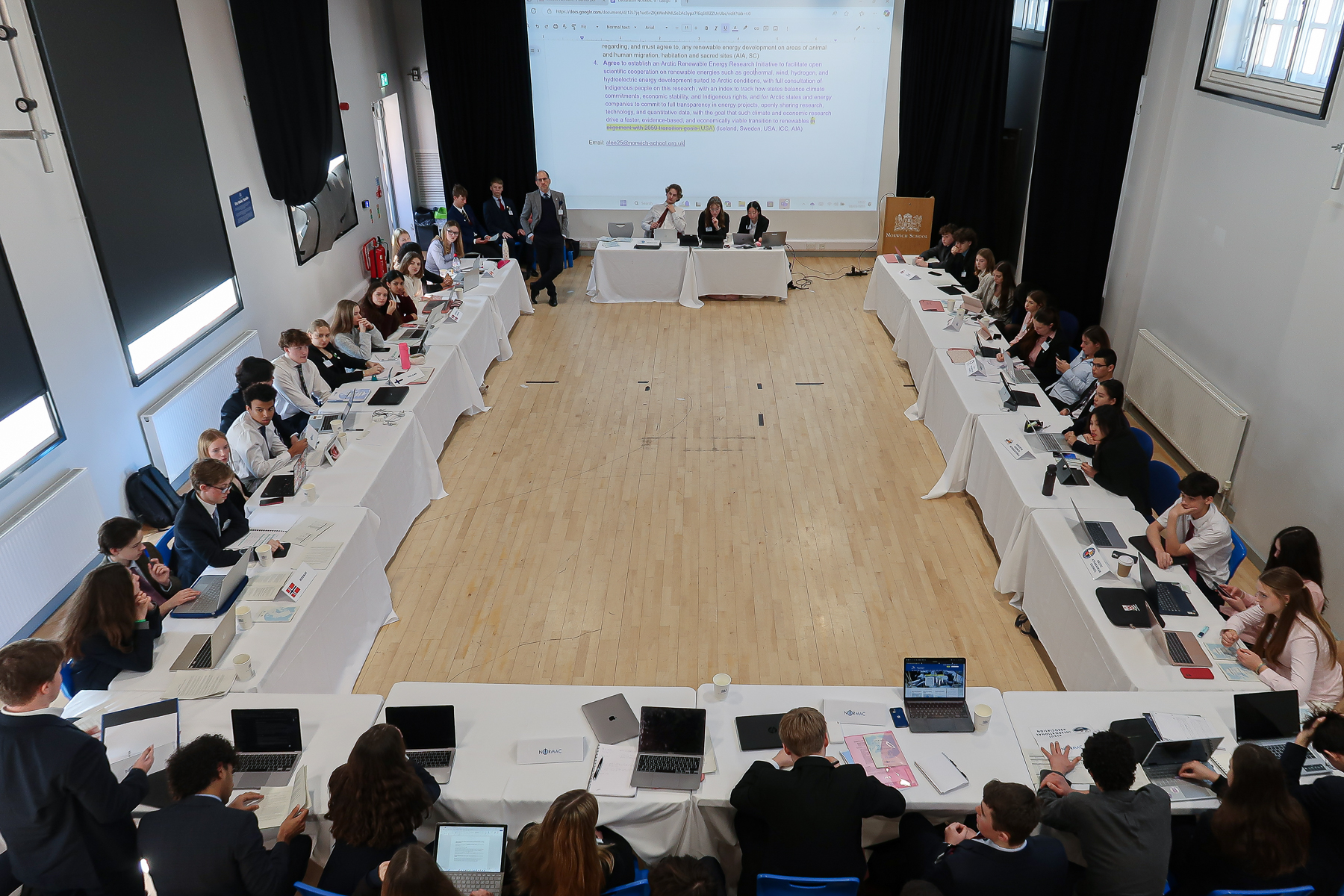
Although the PP delegates felt sidelined, they were hesitant to speak up for fear of being held responsible for any resulting failure to agree a joint declaration on the issue. Yet after careful guided reflection on the costs and benefits of tacit consent versus explicit objection, some of the PP delegates decided that they couldn’t be true to their roles and views without speaking up. As a result, the NORMAC 9 Declaration with which delegates ended the conference included agreement on the issue of the Last Ice Area, but not on the issue of renewable-energy in the Arctic.

Far from being a failure, though, I dare say that delegates learned more from their lack of agreement than they would have from agreement! And the PP delegates especially learned something about themselves: that they had the inner strength to do what they thought was right, and that they could stand and speak for what they considered important despite disapproval from others.
This is the magic of NORMAC 9, and indeed of all my Polar Aspect MACs. The pupils who take part don’t just learn about the Arctic, or even about transferable skills such as public speaking, negotiating and consensus building. They learn something about their own capabilities, and they grow enormously in the process.

And as usual, it wasn’t all hard work. Delegates and Secretariat staff enjoyed a Welcome Dinner at Norwich School after their Opening Ceremony, as well as a formal dinner in the elegant surroundings of Norwich’s historic Assembly House. And we even had an impromptu visit from Budge the Norwich Cathedral cat to enliven the negotiations!
We received lovely testimonials from delegates — a selection:
- It was truly a unique experience offering a perspective which is highly valuable in understanding diplomacy and the Arctic. The organisation was well thought through, and the work to make the detailed documentation possible was amazing.
- I learned how to navigate diplomatic negotiations, balance firm advocacy with compromise, and engage effectively with those resistant to agreement. The conference refined my ability to conduct myself professionally—maintaining sincerity, respect, and strategic diplomacy in high-stakes discussions.
- I deeply enjoyed my time at NORMAC and believe it truly will help me in the future.
- I don’t believe there is any more to be said, I think the conference was overall brilliant.
- Overall a very enriching experience that I will definitely not forget.
And their teachers once again lauded the benefits of NORMAC for their pupils:
- An absolutely fantastic conference, yet again! From start to finish, this was a smooth-running, superbly organised and thoroughly engaging event. Thank you so much for allowing us to participate. Our students have loved it and grown from the experience.
-
Fantastic. We couldn’t be more grateful for the experience that you’ve provided our pupils.
- You have a very special event here. Well done!
And I’m pleased to report that NORMAC continues to win praise from Finland’s Senior Arctic Official, Ambassador Petteri Vuorimäki!

Many thanks as always to Norwich School for hosting, to Mr Tom White for his unfailing support as NORMAC Deputy Director, and to the pupils of Norwich School for their brilliant work as the ninth NORMAC Secretariat! Looking forward to our special tenth anniversary NORMAC in 2026!